pRODUCT Design
Case Study
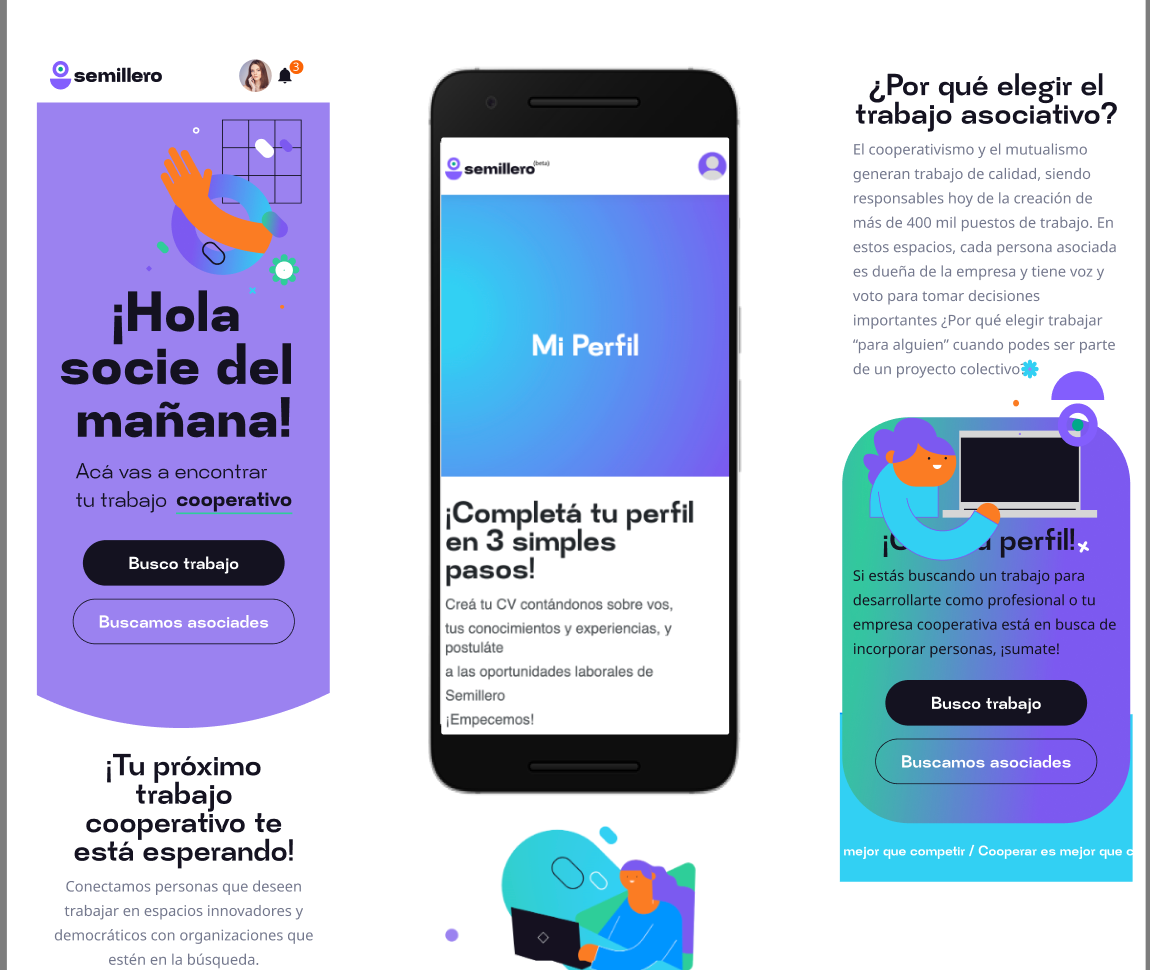
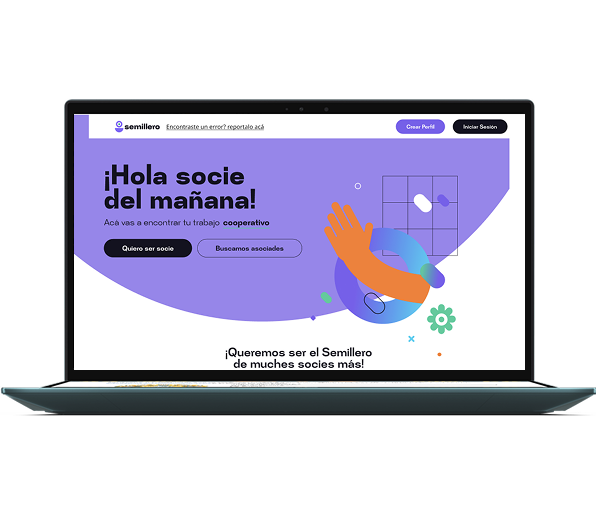
Semillero platform
The Challenge: This was not about building another job board. The cooperative ecosystem in Argentina lacked a digital space aligned with its core values of solidarity, equity, and collective ownership—and capable of translating those values into a usable product.
The challenge was to design a politically aware digital tool from scratch: one that made cooperativism visible as a legitimate and viable career path, while providing clear navigation, orientation, and trust for users exploring alternatives to traditional labor markets.
My Role: Co-led user research and product definition, shaping feature scope, information architecture, and user flows. Worked closely with the Django development team from early stages to align UX decisions with technical constraints, ensuring feasibility, scalability, and a consistent product vision through implementation..
Extended Team:
Worked as part of a design duo within a distributed team of 6+ developers and a product manager. Coordinated design decisions across a 10-person cooperative network (FACTTIC), aligning timelines, dependencies, and implementation constraints in a fully remote setup.
Key Product DECISIONS
This project was a ground-up product initiative. FACTTIC and INAES sought to create a new digital tool to strengthen the cooperative job ecosystem. Our cooperative (ALT) was brought in to lead the product design, transforming this vision into a viable, inclusive platform built from scratch.
Rather than following a linear design process, this project was shaped by a set of critical product decisions. Each one responded to real constraints—organizational, technical, and social—and directly influenced how the platform would be used and sustained.
Framing the product through a gender-inclusive lens
Early research and interviews showed that access to cooperative jobs was not only a visibility issue, but also one of language, trust, and legitimacy. We embedded a gender perspective from the discovery phase onward, shaping terminology, flows, and validation criteria to reduce exclusion and friction.
Designing with technical constraints as a first-class input
User flows, information architecture, and prototypes were developed in close collaboration with the Django team. This allowed us to anticipate constraints early, avoid speculative features, and ensure that design decisions translated cleanly into implementation.
Defining a focused MVP to align multiple cooperatives
With several organizations involved, scope creep was a real risk. We prioritized a reduced but coherent MVP, defining core user journeys and personas to align stakeholders around shared goals while keeping the product technically feasible and maintainable.
Validating critical flows to reduce failure points
We concentrated usability testing on high-risk interactions—profile creation and job application—where drop-off or confusion would undermine the platform’s purpose. Findings directly informed interaction, copy, and hierarchy refinements before development was finalized.
Product Features
The platform connects cooperatives and job seekers through a focused set of features designed to support access, trust, and long-term sustainability within the cooperative ecosystem:
Inclusive Profile & Job Management
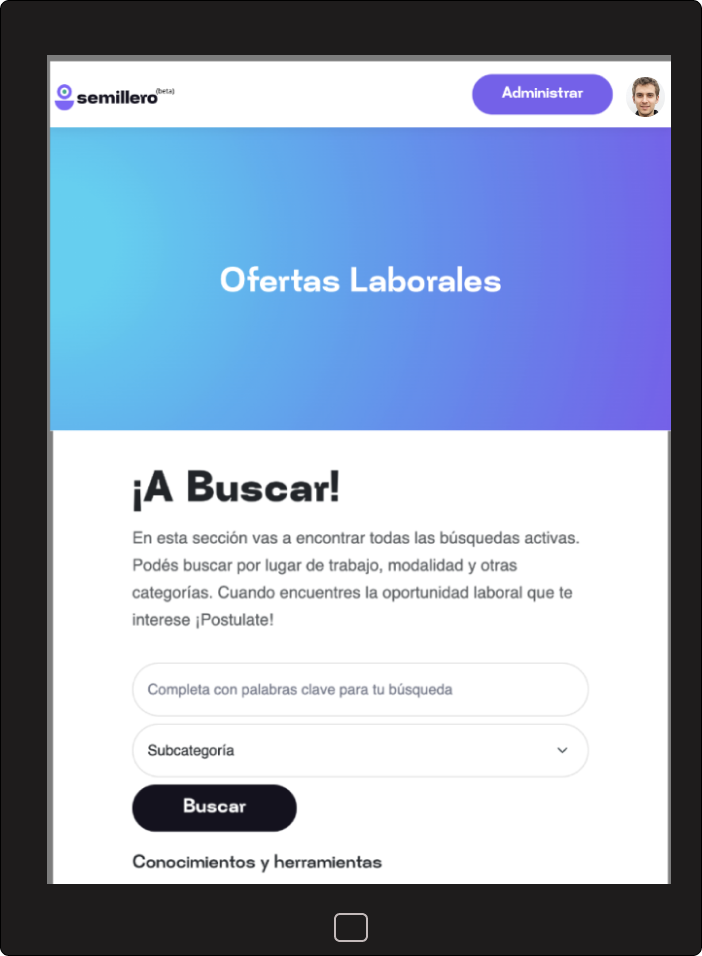
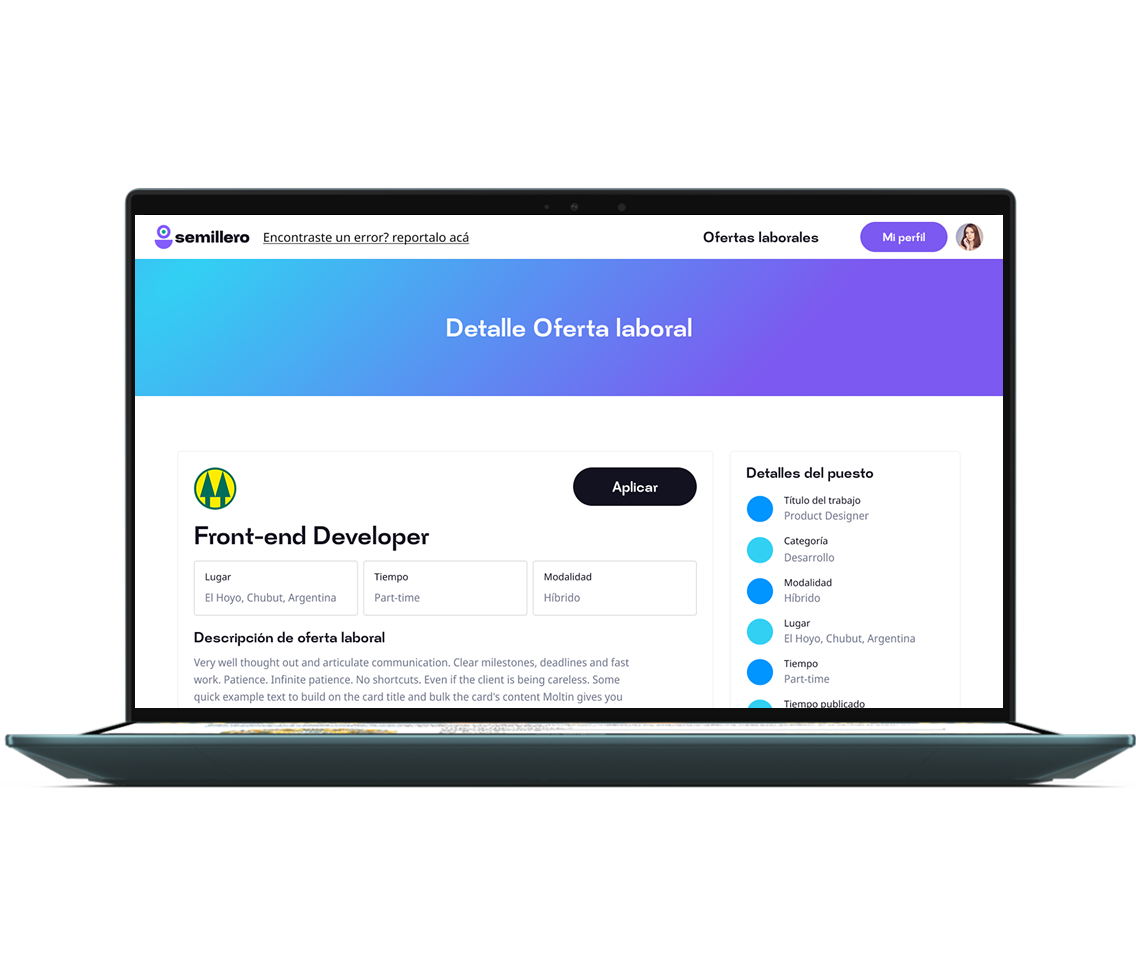
Profiles and postings structured to reflect cooperative values while remaining clear, comparable, and operationally usable.
Personalized, Value-Driven Job Matching
Matching logic prioritizes alignment in principles and working conditions, not just roles or technical skills.
Gender-Perspective & Safety-First Design
Language, flows and data collection were designed to reduce exposure, avoid unnecessary disclosure, and support safer participation.
Built for Cooperative Ecosystem Scale
The system was architected to support multiple cooperatives and evolving use cases without fragmenting the user experience.
CORE CONTRIBUTIONS
Product Strategy from a Blank Slate
Led the foundational product definition for a first-of-its-kind platform. Translated the political vision of cooperativism as a career path into a viable MVP by defining scope, priorities, and boundaries through participatory workshops and ecosystem-level research.
Gender-Inclusive Research
& User Flows
Designed and led gender-perspective research to identify exclusion points in cooperative and tech hiring processes. Translated findings into end-to-end user flows—from profile creation to job application—reducing exposure, friction, and bias while maintaining operational clarity.
Technical Co-Design with Development
Designed UX/UI in direct partnership with the Django development team, treating technical constraints as design inputs. This approach prevented rework, aligned UX intent with backend logic, and supported consistent delivery across a distributed, inter-cooperative team.
Traditional job platforms are built around competition and extraction, leaving little room for solidarity, diversity, or collective ownership. For the cooperative ecosystem, this meant that replicating a standard job board would miss the point.
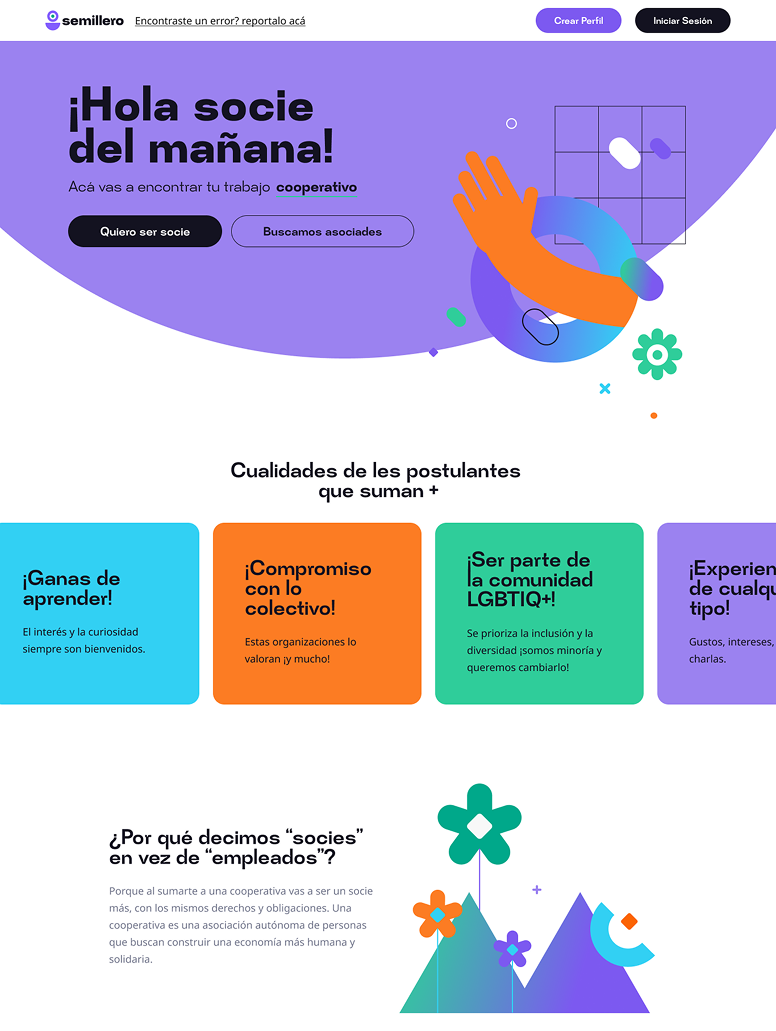
The challenge was not to digitize hiring, but to design a digital home capable of supporting a different way of working.
Our mission: design that home.
The Insight That Changed Everything
Our gender-perspective research revealed a critical gap: fear of discrimination was a major barrier for diverse talent entering the cooperative tech space. We understood that a platform focused only on functional matching would fail its social and product objectives.
Our pivotal realization: safety is a product feature.
This shifted the platform from a passive listing tool to an active, inclusive ecosystem, guiding three key design decisions:
Inclusive language and interaction design, ensuring representation without forcing disclosure.
A community-driven profile system, prioritizing collective values and context over individual skills alone.
Transparent application and follow-up flows, designed to build trust, predictability, and care at every step.
Why This Design Matters
This project demonstrated that digital labor platforms are not neutral by default. Choices around language, flows, and data collection directly shape who feels safe to participate and who stays out. Designing for safety required treating inclusion, trust, and clarity as core product requirements—not as add-ons.
Showed how gender perspective can be operationalized through UX decisions, not just stated as values.
Balanced cooperative principles with real-world hiring constraints, avoiding idealized but unusable solutions.
Established a scalable foundation for future features without compromising accessibility or trust.
Other Recent Works